Homeowners' pick for appliance repair across Alabama
Refrigerator Repair in Montgomery — Book a Visit Today
We diagnose and repair refrigerators in Montgomery, and the questions come before the parts. Milk turning early, soft ice cream, and a back wall furry with frost point in different directions. Is the compressor running nonstop? Are the vents inside blowing air at all? A warm fridge with a cold freezer usually means airflow, not refrigerant. We check the defrost cycle, the door seals, the fan and the drain line before naming a part. Homeowners often call us after a second week of throwing out food. Do not wait that long. Describe what you see.
Call (800) 712-6387- Real people on the phone
- 7 days a week
- Quote in writing before any work
Taking calls until 5:00 PM CT
Common refrigerator faults in Montgomery homes
- "Fridge is warm but the freezer is freezing" Airflow problem: evaporator fan, frost-blocked coil, or a stuck air damper
- "There's water pooling under the crisper drawers" Blocked defrost drain line, or a torn door gasket letting humid air in
- "It runs constantly and never shuts off" Dirty condenser coils, a failing thermostat or sensor, or a refrigerant-side fault
- "The ice maker stopped dropping cubes" Water inlet valve, frozen fill tube, or a dead ice maker module
- "It clicks every few minutes, then goes quiet" Compressor start relay or overload protector tripping on retry
Montgomery coverage
From Montgomery we cover 36104, 36106, 36108, and 36110, plus nearby Millbrook, Prattville, and out toward Troy and Selma.
Other repairs we do in Montgomery
- Washer Repair
- Dryer Repair
- Dryer Vent Cleaning & Repair
- Dishwasher Repair
- Oven Repair
- Stove & Range Repair
Refrigerator Repair in cities near Montgomery
- Millbrook refrigerator repair
- refrigerator repair for Prattville homes
- Pike Road refrigerator repair
- refrigerator repair for Emerald Mountain homes
- Refrigerator Repair — Wetumpka, AL
Refrigerator Repair service hub → · Every appliance we fix in Montgomery →
What homeowners in Montgomery get from an independent shop
| G Appliances MD | Big-box repair chains | Handyman listings | |
|---|---|---|---|
| Written quote before any work | ✓ | ✕ | ✕ |
| Live answer seven days a week | ✓ | ✕ | ✓ |
| Every major brand, gas or electric | ✓ | ✓ | ✕ |
| No manufacturer targets to hit | ✓ | ✕ | ✓ |
| Crews familiar with homes like yours | ✓ | ✕ | ✓ |
Homeowners on how the visit went
“Zero pressure at any point. The quote sat in my inbox for two days while I decided, no chasing calls.”
Rita M.Luverne, AL“He leveled the machine, replaced the pump, and ran a full cycle before leaving. Thorough.”
Dean S.Eutaw, AL“Wall oven is fifteen years old and they still sourced the part in three days.”
Vera K.Hartford, ALRefrigerator Repair in Montgomery — quick answers
How do you figure out what's wrong?
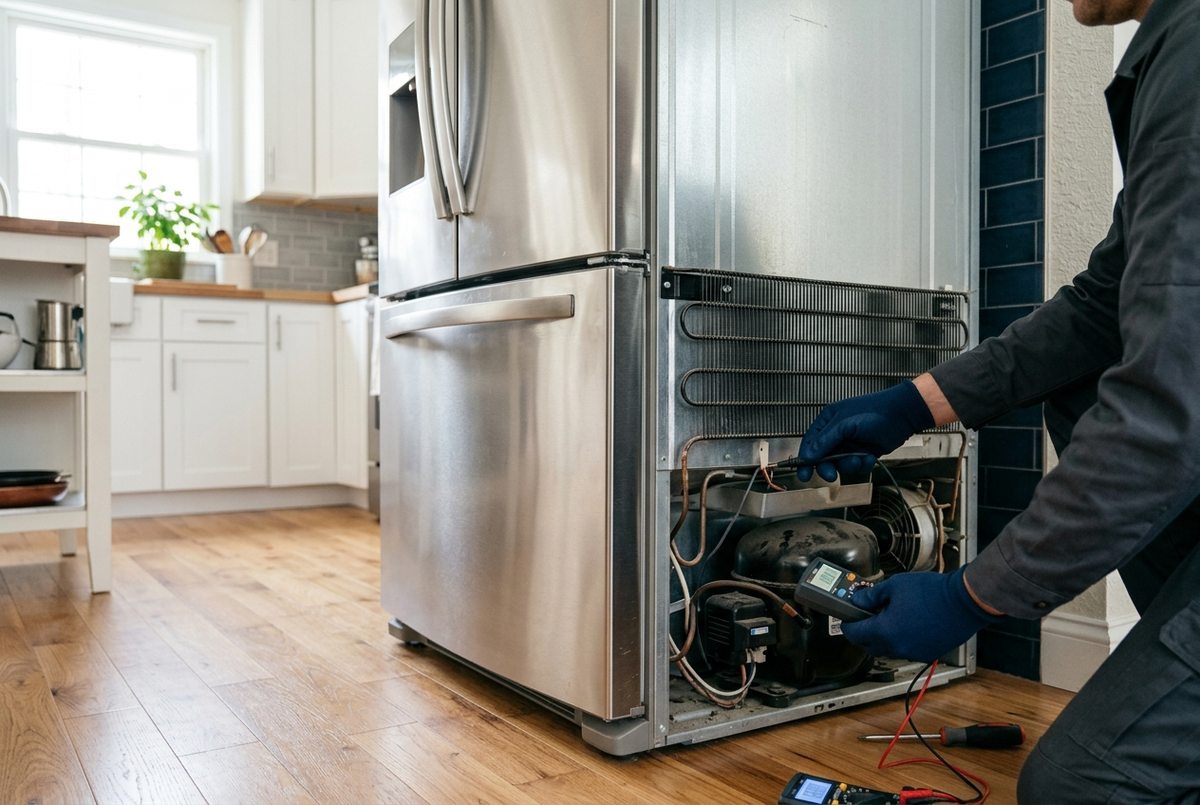
We start with your description, since sounds and timing narrow things down fast. Then we measure compartment temperatures, inspect the evaporator for frost, test the fans, and check electrical components with meters. Guesswork replaces parts. Testing replaces the right one.
My fridge is frosting up in the back. Is that serious?
Frost on the rear panel usually means the defrost cycle stopped working. Heater, thermostat, sensor, or board are the usual suspects. Left alone, that frost blocks airflow and the fresh food side warms up. Worth looking at soon.
Should I try defrosting it myself first?
Unplugging it and letting it thaw overnight often restores cooling for a while. That's useful information, not a fix. If cooling comes back after a thaw, the defrost system is the culprit and it will fail again.
Is it worth repairing an older refrigerator?
Depends on the failure. A relay, fan, gasket, or drain clog is usually a sensible repair on almost any age unit. Sealed-system damage on a very old fridge is a different conversation. We tell you which side you're on.
How soon can you get to my house in Montgomery?
Tell us the symptom when you call us and we'll match you to the next open window, often same week. Morning and afternoon arrival windows are available on most weekdays. If your fridge is warming up or a leak is spreading, say so first — those move ahead of routine checks.
How it works
- Step 1
Describe the symptom
Tell us what you hear, smell, or see. Is it grinding, is there a puddle on the floor, is a code blinking at you? Small details narrow the list of likely causes before we ever pull the machine away from the wall.
- Step 2
We examine the machine
A technician works a checklist: power, controls, sensors, motors, seals, drainage. We test instead of guessing. Then we walk you through the actual fault and what your repair options are.
- Step 3
You choose the treatment
Some faults are worth fixing the same day. Others mean the appliance is near the end of its life. We tell you which one you're looking at, and we finish the repair once you say go.
- A real person answers
- Open 7 days
- Written quote before work starts
Why homeowners call us
- We think like diagnosticiansSwapping parts until something works costs you time. We trace the symptom back to its cause and confirm it with a test, then repair the thing that actually failed rather than the thing that merely looked suspicious.
- Second opinions are fine by usSomeone already told you the compressor is done, or that the control board is fried? Bring us in to check. We'll run our own examination and tell you honestly whether that diagnosis holds up.
- Brand-independent serviceWe're an independent repair company, and we work on refrigerators, washers, dryers, dishwashers, ovens, ranges, and freezers from all major brands. No brand steers our recommendation toward replacement over repair.
- Straight talk on repair or replaceNot every appliance deserves a rescue. If the numbers and the condition point toward a new unit, we say so. What you get is facts about your machine, not pressure to book work.
- All major brands, gas & electricEvery major appliance brand, gas and electric, handled by an independent shop.
- Straight answersWhen a repair doesn't make sense, we tell you, sometimes before we even roll a truck.
Refrigerator Repair in Montgomery
Each broken day has a price tag
Tell us the symptom, sign off on the written quote, get the machine back. Starting takes a minute.
- A real person answers
- Open 7 days
- Written quotes
- All major brands
- Gas & electric
Rather not call? Get a free quote →