Homeowners' pick for appliance repair across Alabama
Microwave Repair — Book a Visit Today
We repair microwaves across Alabama, and the fastest way to start is to tell us what yours is doing. A microwave gives you clues before it quits. Humming with no heat points one way, sparks inside point another, and buttons that ignore you point somewhere else entirely. We start with the symptom instead of a guess. A visit means listening to the machine run, checking the door interlocks, testing the high-voltage side with the unit unplugged and discharged, then looking at the magnetron, diode, capacitor, and control board in that order. Over-the-range units get extra attention at the mounting and the vent. After that we explain what we found in plain words, including when a replacement makes more sense than parts. Built-in and drawer models are worth a look before you write them off. Describe what yours is doing and we will tell you what it likely means.
Call (800) 712-6387- Real people on the phone
- 7 days a week
- Quote in writing before any work
Taking calls until 5:00 PM CT
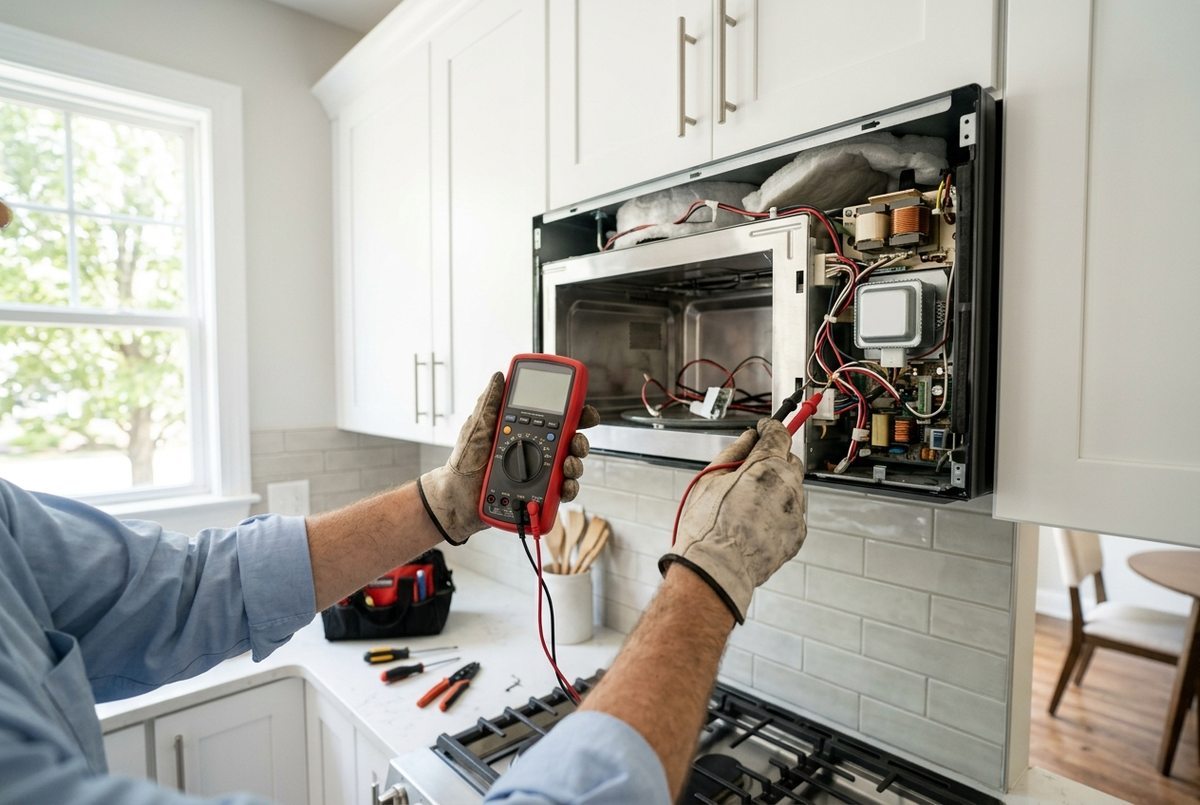
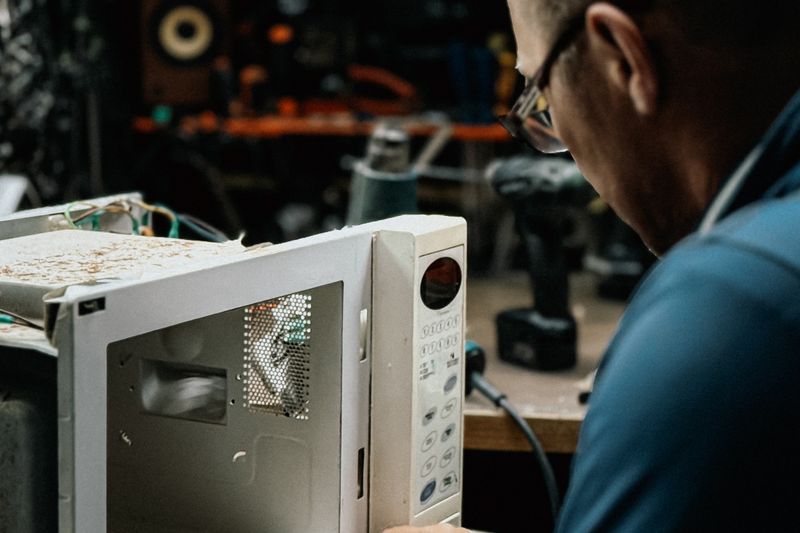
The microwave symptoms we hear most
- It runs but my food stays cold High-voltage failure in the magnetron, diode, capacitor, or transformer
- Sparks and popping inside Burned waveguide cover, damaged cavity paint, or metal arcing
- Nothing happens when I shut the door Door interlock switch or latch assembly failure
- Buttons do nothing or beep on their own Membrane keypad or control board fault
- Loud grinding and the plate won't spin Turntable motor, coupler, or roller ring wear
Safe things to check first
Worth a look before you call — sometimes it saves you the visit.
- 1Unplug the unit for a full minute, plug it back in, and see whether the display resets to normal.
- 2Confirm the outlet has power by testing a lamp in it, and reset the breaker if it tripped.
- 3Open and close the door firmly, looking for a bent latch, food debris, or a loose hinge.
- 4Lift out the glass plate and roller ring, wash them, and check the drive coupler underneath for cracks.
Guides & troubleshooting
What homeowners get from an independent shop
| G Appliances MD | Big-box repair chains | Handyman listings | |
|---|---|---|---|
| Written quote before any work | ✓ | ✕ | ✕ |
| Live answer seven days a week | ✓ | ✕ | ✓ |
| Every major brand, gas or electric | ✓ | ✓ | ✕ |
| No manufacturer targets to hit | ✓ | ✕ | ✓ |
| Crews familiar with homes like yours | ✓ | ✕ | ✓ |
Homeowners on how the visit went
“Second visit ever, same easy process. Washer spins like it did the day we bought it.”
Danielle M.Luverne, AL“They told me flat out the old freezer was not worth the part cost and helped me plan the swap instead.”
Tom B.Eutaw, AL“Called at 8, booked by 8:15, fridge cold before dinner. I did not expect that speed.”
Angela P.Hartford, ALMicrowave Repair — quick answers
Is a microwave that won't heat worth repairing?
Often yes, especially built-in, drawer, and over-the-range units. The heating side uses a handful of parts that can be tested one at a time. Countertop models are a closer call. We tell you which side of that line yours falls on.
Why do you insist on never opening it myself?
The capacitor can hold a dangerous charge long after the cord is unplugged, and that charge does not care that the display is dark. Discharging it takes the right tool and a specific order of steps. Leave the panel closed.
Do you handle over-the-range and built-in models?
Yes. Those involve mounting brackets, vent routing, and cabinet clearances on top of the usual electrical work. We bring help for the lift when a unit has to come down and go back up level.
What causes arcing inside the cavity?
Usually a splattered waveguide cover that has burned, or chipped interior paint exposing bare metal. Stray foil and metal-trimmed dishes do it too. Stop using the unit once you see sparks and let us inspect the cavity.
Can a microwave leak radiation after a repair?
Leakage comes from a damaged door seal, a warped door, or a failed interlock. We check door alignment and seal condition during service and can meter the unit. A door with visible damage gets addressed before the microwave goes back in use.
How long does a typical visit run?
Most diagnoses take under an hour. If the part is common we often finish the same trip. Control boards and magnetrons for less common models may need ordering, and we schedule the return once the part lands.
How it works
- Step 1
Describe the symptom
Tell us what you hear, smell, or see. Is it grinding, is there a puddle on the floor, is a code blinking at you? Small details narrow the list of likely causes before we ever pull the machine away from the wall.
- Step 2
We examine the machine
A technician works a checklist: power, controls, sensors, motors, seals, drainage. We test instead of guessing. Then we walk you through the actual fault and what your repair options are.
- Step 3
You choose the treatment
Some faults are worth fixing the same day. Others mean the appliance is near the end of its life. We tell you which one you're looking at, and we finish the repair once you say go.
- A real person answers
- Open 7 days
- Written quote before work starts
Why homeowners call us
- We think like diagnosticiansSwapping parts until something works costs you time. We trace the symptom back to its cause and confirm it with a test, then repair the thing that actually failed rather than the thing that merely looked suspicious.
- Second opinions are fine by usSomeone already told you the compressor is done, or that the control board is fried? Bring us in to check. We'll run our own examination and tell you honestly whether that diagnosis holds up.
- Brand-independent serviceWe're an independent repair company, and we work on refrigerators, washers, dryers, dishwashers, ovens, ranges, and freezers from all major brands. No brand steers our recommendation toward replacement over repair.
- Straight talk on repair or replaceNot every appliance deserves a rescue. If the numbers and the condition point toward a new unit, we say so. What you get is facts about your machine, not pressure to book work.
- All major brands, gas & electricEvery major appliance brand, gas and electric, handled by an independent shop.
- Straight answersWhen a repair doesn't make sense, we tell you, sometimes before we even roll a truck.
Microwave Repair
Small faults become big ones on a schedule of their own
Describe the symptoms and we'll book the visit — takes about a minute.
- A real person answers
- Open 7 days
- Written quotes
- All major brands
- Gas & electric
Rather not call? Get a free quote →